
 News Center
1. The scale of the industry market is large, and the concentration still has room to improve
1.1 the condiment industry has a large space, and the total scale is expected to reach 550 billion yuan in 2025
There are many kinds of condiments in China, which are widely used in various fields of diet. Condiments refer to auxiliary foods that can increase the color, aroma and taste of dishes, and have the functions of removing fishy smell, increasing aroma, increasing freshness and so on. There are many kinds of condiments in China. According to the nature of commodities, they can be divided into brewing, pickles, fresh vegetables, dry goods, aquatic products, etc. according to the shape of finished products, they can be divided into sauce, soy sauce, juice, flavor powder and solid. According to the taste feeling, they can be divided into salty, sweet, bitter, spicy, sour, fresh and fragrant. According to the composition, they can be divided into single and composite condiments.
China's condiment industry has a large market scale and its growth rate has increased. The revenue of Chinese condiment industry increased from rmb39.5 billion in 2020 to rmb25.7 billion in 2014. In terms of output, the total output of seasoned food of China's top 100 enterprises increased from 7 million tons in 2013 to 16.27 million tons in 2020, and the seven-year CAGR was 14.17%.
In 2025, the market scale of China's condiment industry will reach 550 billion yuan. The revenue of China's condiment industry increased from 259.5 billion yuan in 2014 to 395 billion yuan in 2020, and the six-year CAGR was 7.25%. Assuming that the CAGR of condiment market scale fluctuates around 7% from 2021 to 2025, taking 6%, 7% and 8% respectively, we can get that the market scale of condiment industry in 2025 is 528.6 billion yuan, 554.0 billion yuan and 580.4 billion yuan, and the middle value is about 550 billion yuan.
Volume price splitting:
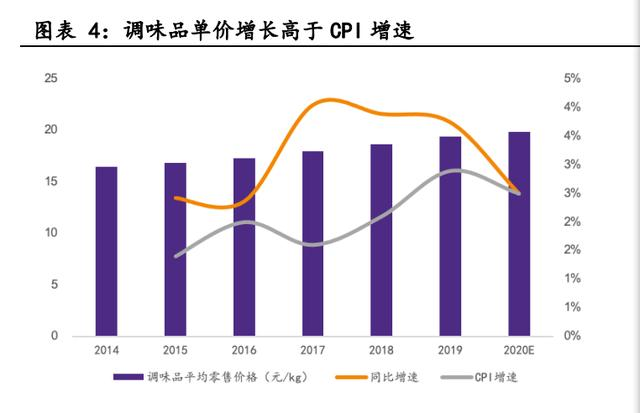
Price: the unit price of China's condiment industry in 2019 is about 19.8 yuan / kg, and the CAGR in 2014-2019 is about 3.29%;
Volume: the seasoning output of China's top 100 enterprises in 2020 was 16.271 million tons, and the CAGR from 2013 to 2020 was 12.81%. Among them, the production capacity of Haitian flavor industry, Zhongju high tech, Qianhe flavor industry, Hengshun vinegar industry and Jiajia food in 2020 was about 400, 70, 56, 26000 and 300000 tons, and the long-term planned production capacity was 450, 400, 115, 70 and 350000 tons respectively. Haitian's existing production capacity and planned total production capacity ranked first in the industry.
1.2. The market concentration is low and there is still room for improvement
Compared with Japan and South Korea, the per capita consumption of condiments in China is still low, which has great room for improvement. Due to the similar eating habits between China and Japan and South Korea, it is highly comparable. The per capita retail sales of Japan and South Korea are 10.04 and 2.02 times that of China respectively, and the per capita retail price is much higher than that of China. According to the average value of condiment consumption in Japan and South Korea, there is still about six times the growth space at the retail end of condiments in China, and because China's population base is much higher than that of Japan and South Korea, the market space at the retail end may be higher.
The regional characteristics of condiments are obvious, which leads to the large regional viscosity of condiments in China. As China has a long history and vast territory, and most condiments are fermented and pickled products, each region has formed a unique seasoning system, which is closely related to local living habits, environment, climate and other factors. The eight major cuisines formed have different tastes, among which Sichuan cuisine is spicy, Guangdong cuisine is original, Hunan cuisine is spicy, Zhejiang cuisine is fresh, Jiangsu cuisine is sweet, Fujian cuisine is salty and sweet in the South and spicy in the north, Shandong cuisine is salty and fresh, and Huizhou cuisine sauce has a strong flavor. Specifically, vinegar has the strongest regionality, including Shanxi old vinegar, Zhenjiang balsamic vinegar, Sichuan Baoning vinegar and Yongchun old vinegar; Condiments such as soy sauce and cooking wine are relatively weak in region.
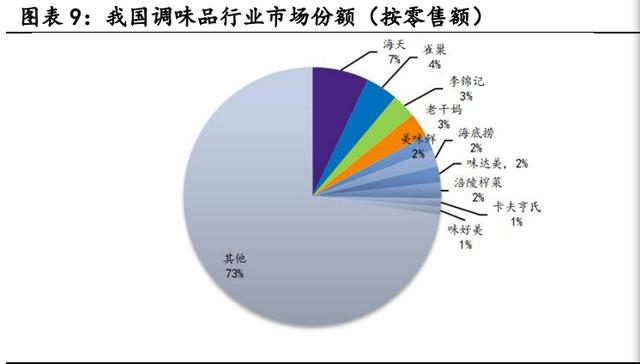
The nationwide expansion of condiments is relatively difficult and the concentration is low. Haitian, as China's national leader in condiments, has a market share of only about 7%, and the income of the top 100 condiment enterprises in China accounts for less than 30% of the total industry income. CR3 and CR10 of condiments in China are about 14% and 25%, much lower than those in South Korea, Japan and the United States, with CR3 of 32%, 18% and 15% and CR10 of 60%, 30% and 28% respectively. However, it can still be seen that the concentration of the condiment industry has continued to rise in recent years. Especially since 2020, affected by the epidemic, the profits of the condiment industry have continued to be under pressure due to the rise of raw materials, and the differentiation of enterprise operation has accelerated. In this context, the condiment industry continues to optimize, some small and medium-sized enterprises will be cleared out in the fierce competition or by means of mergers and acquisitions, bankruptcy and reorganization, and the market share of the industry is expected to continue to concentrate on leading enterprises. (report source: future think tank)
2. Competition pattern: rapid development of sub categories and focus on boom categories
2.1. The development stages of each category are different, and the subdivided categories are waiting for gold mining
There are many kinds of condiments in China, and the main sub categories are still in the stage of rapid development. There are dozens of types of condiments in China, and the development stages of each sub category are different. Among them, soy sauce, vinegar, oyster sauce, cooking wine and other traditional condiments are used in large quantities, and the market scale is in the forefront among the subdivided categories. At present, they are still in the growth stage, with rich consumption scenes, continuous subdivision of categories, and a significant trend of upgrading to high-end; Monosodium glutamate has begun to decline due to high homogeneity and health; Chicken essence, chicken powder and salt have high market penetration, enter the mature stage, and have the trend of being replaced by soy sauce; Compound condiments started late and are still in the import stage, with rich product categories.
2.1.1 soy sauce: the largest subdivided industry, focusing on structural upgrading and concentration improvement
The volume and price of soy sauce industry have risen simultaneously, and the market scale may exceed 100 billion. The retail sales of China's soy sauce industry increased from 41.1 billion yuan in 2012 to 87.4 billion yuan in 2020, with a CAGR of 9.90% in 8 years. In terms of output, it increased from 5.96 million tons in 2010 to 13.44 million tons in 2020, and the 10-year CAGR was 8.48%. After Japan's soy sauce industry experienced rapid growth in per capita consumption in the 1970s, soy sauce sales began to decline due to the replacement of soy sauce by compound condiments and subdivided soy sauce derivatives. At present, China's per capita soy sauce consumption is about 8 liters / year, which is still in the stage of improvement. Compared with the peak of soy sauce consumption in Japan in the 1970s, there is still about 50% growth space. Therefore, we believe that China's soy sauce demand still has great room for improvement.
Volume price splitting:
Price: the retail price of soy sauce in China is about 6505 yuan / ton, and the average price CAGR in recent five years is about 2.5%. Among them, the ex factory price of Haitian, Zhongju hi tech and Qianhe soy sauce in 2020 is 5317, 6232 and 5206 yuan / ton, and the average cost price is 2885, 3189 and 2681 yuan / ton;
Volume: the output of soy sauce in China will be 13.44 million tons in 2020, and the output CAGR in recent five years is about 5.8%. Among them, the output of Haitian, Zhongju hi tech and Qianhe soy sauce in 2020 is 238, 500000 and 200000 tons respectively, and the sales volume is 245, 500000 and 200000 tons respectively.
China's high-end soy sauce market has expanded rapidly, from 1.31 million tons in 2014 to 2.5 million tons in 2020, with a CAGR of 11.37%, higher than the overall growth rate of the soy sauce industry. It is expected that China's high-end soy sauce market share will reach 36 billion yuan in 2025. In 2016, the retail price of soy sauce Rose from 13.4 yuan / ml to 31.500ml/ml, but the retail price of soy sauce continued to rise from 13.4 yuan / ml to 31.500ml/ml in 2016. The main reason is that the upgrading of product structure drives the average price of soy sauce to increase. For example, the price of zero added soy sauce and organic soy sauce is 2-4 times that of ordinary first-class soy sauce. Moreover, due to the low unit price of soy sauce and the small single consumption at the household consumption end, consumers are less sensitive to price increase and are more likely to accept high-end soy sauce.

Links
Chengdu taihefang Brewing Co., Ltd
Contact Us
 Wechat QR code
