
 News Center
Since October 2021, condiment enterprises have been "rising" continuously. Haitian flavor industry, Li Jinji group, Zhongju high tech, Hengshun vinegar industry, Jiajia food, Tianwei food, Xuetian salt industry, suyanjingshen, Fuling mustard and other leading enterprises have announced to raise product prices. Other large, medium and small brands have followed up successively. Even the old godmother who has adhered to the price belt for a long time announced to raise prices in March 2022.
However, the price increase of products in the condiment industry is not immediate. Based on the circulation characteristics of condiments, the market impact of "price rise tide" on the whole chain needs a certain time to be gradually transmitted to the terminal, and needs to be verified by four rounds at both ends: one is the market verification in the peak season and off-season at the catering end, and the other is the market verification in the peak season and off-season at the circulation end, so as to truly judge whether this wave of price rise is successful.
Now that the first quarter of 2022 has passed, what new changes has the rising price of condiments brought to the market?
01
Some brands have made profits
The possibility of raising prices again is not ruled out
At present, the financial reports of most listed condiment enterprises in 2021 and the first quarter of 2022 have been released, and the profitability of some brands has also improved significantly after the price rise.
Head brands such as Haitian flavor industry still maintained positive profit growth in 2021 under the background of significant upward cost pressure. Its Q4 gross profit margin in 2021 was as high as 38.13%. In addition to the scale benefit and low cost sharing, the gross profit boost benefit brought by the price increase was also quite obvious.
In 2021, Tianwei food increased its efforts to destock, and the effect was also very obvious. At the same time, through the contraction of channels and costs and the smooth price increase of Q4 in 2021, the profit side of Q1 in 2022 also grew rapidly.
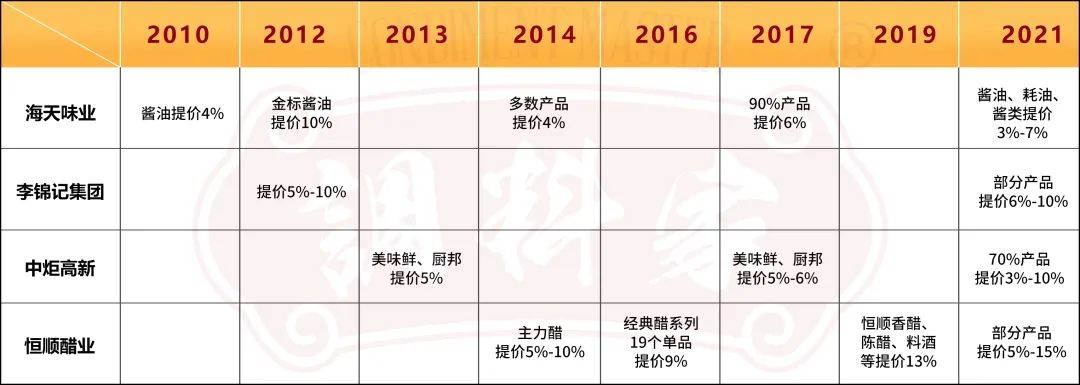
By reviewing the previous price increases of some head condiment enterprises, we will find that the price rise tide from Q4 to Q1 in 2021 to 2022 is very similar to the price rise tide from 2010 to 2012. These two waves of price increases are not strategic price increases initiated by enterprises upgrading products due to the rise of economic index and the upgrading of consumer demand.
On the contrary, under the external force of the economic downturn and the continuous impact of the epidemic, the CPI is still rising step by step due to the continuous input inflation in 2022, the soaring international food prices are superimposed with the frequent natural disasters in some regions, and the prices of grain crops such as soybeans are still in a significant upward channel. Driven by multiple factors, the cost prices of raw materials and packaging materials of condiment enterprises are still rising all the way. Under the general trend of increasing cost pressure, it is not ruled out that some condiment enterprises will raise prices again in the future.
02
Under head leading pressure
Some people follow the rise, others wait and see
After the price increases of the top brands of condiments, according to the incomplete statistics of seasoner, enterprises including Taitaile, Daqiao, Zilin, Beijing veteran, Pixian Douban, Dandan Douban, grassland red sun, Jianhua sesame oil, dechangyuan, liupo, Chongqing Maoge, Guangdong Baijia fresh food and so on also followed suit.
After all, the market is depressed, the price of raw materials is "high", and the impact of sporadic epidemics continues... In this "bad" environment, condiment enterprises choose to raise the price by about 10%. First, they try to test the market response, and second, they ensure the profitability of the enterprise. As for whether the rise is successful, it is necessary to test the comprehensive competitiveness of the enterprise.
For example, a Chongqing pickled mustard, whose products are more targeted at the communication end users, has increased by 3% - 6%, which has little impact on the overall sales volume. However, some brands have difficulty selling after the price rise. On the one hand, consumers' recognition of new packaging is still insufficient. On the other hand, at the market level, new and old packaging coexist in the market, resulting in the "conflict" between products and prices. Although consumers are not sensitive to the slight fluctuation of retail price at present, when the retail price of 70g products of the above brands is increased from 2 yuan to 2.5 yuan, it is only 50 cents expensive, and consumers are not willing to pay.
Therefore, in the process of visiting the market, the reporter of seasoner found that there is still great uncertainty whether the current round of price rise can be successfully transmitted to the terminal. Although the "price rise trend" has been formed, some enterprises prefer to compress their profit space rather than follow the rise easily.
Because the market environment faced by this round of price increase is far inferior to the two rounds of price increase cycles in 2012 and 2017. At that time, the market demand side was in the stage of economic recovery, and the transmission of price rise was relatively smoother. This price rise was superimposed with multiple adverse factors such as the decline of market vitality, limited consumption and the impact of the epidemic. Therefore, it is unknown whether the price rise can be truly accepted by the end market.

After the price rise of some brands, businesses are still selling inventory!
For example, Haitian, in the past, every price increase was very helpful to clean up inventory, because distribution customers such as farmers' trade would rush for goods at low prices. However, with the price increase at the end of last year, most distribution customers had no desire to suppress goods, resulting in increased inventory and slow moving sales of individual dealers. In contrast, it is more difficult for other brand terminals to adjust the price successfully. On the one hand, the ex factory price of the product has been adjusted, but on the other hand, the cost subsidies given to the market have also been increased accordingly. In the last accounting, it was found that there was only a "lonely" rise.
Another example is a condiment enterprise in Meishan, Sichuan. Although it has also increased its price due to the rise of raw materials and products, the increase in its retail price is far less than that of its cost. The relevant person in charge of the company said to the seasoner: "Our chili oil increased by 30%, vegetable oil and soybean oil increased by 40%. The sales volume failed to meet the expectations, could not support the profit space at all, and the proportion of operating expenses became larger. The hard costs of labor and plant remained high. Do you think we were under great pressure? So even if we raised the price last year, the transmission cycle to the terminal was longer than expected. Now it has not been fully adjusted and is still in the process of combing."
Some dealers said bluntly: because the manufacturer did not give enough time and space for price increase, it did not succeed in price increase for downstream customers, so it had to maintain the market with low gross profit or even loss. "If you want customers or profits, choose one from the other. What do you do? If their manufacturers rise by 5%, we will rise by 20% when it is transmitted to the consumer terminal. Consumers will not buy when they see that the price rises too much. However, in a word of conscience, the sales volume is affected more by the epidemic, which has little to do with the price rise."
03
Regional market performance varies
Catering and circulation experience are quite different
In view of the new wave of "price rise tide" from the end of 2021 to the beginning of 2022, the specific performance of each regional market is different, and I don't know when the tide will rise and fall. At least, for enterprises and dealers who take the catering end and circulation end, the feeling of the market transmission effect of price rise is also different.
Let's first look at the catering side. Although the catering terminal accounts for the highest proportion in the consumption channels of condiments, due to the impact of the epidemic, the whole catering industry continues to close stores. Therefore, the condiments at the catering side are also affected the most. Both enterprises and dealers are very sad.
The first is the long-term closure caused by the epidemic, and the second is the shrinkage of the consumer side. To put it bluntly, there are fewer and fewer people eating out. In addition, the catering channel is a special channel that is "difficult to attack and easy to defend". For the catering terminal, the brands and channels of purchasing raw materials are relatively fixed, especially the seasonings that determine the stability of dishes. Generally, it is not easy to change the brands, Therefore, even if the price rise of raw materials has a great impact on their profits, it is difficult for them to raise the price of b-end. Both enterprises and dealers can only try to reduce their operating costs, resulting in limited profit space.
Especially dealers in Wuhan, Shijiazhuang and other places admitted that this wave of manufacturers' price increase was not successful, and the offline dynamic sales volume has not recovered for a long time, so even if the manufacturers' price increase, they don't want to press too much inventory. "It's good to go normally. The rise is so strong. If we follow the rise, it's too expensive. It's better to change a product. No one comes to buy it. What business do you do?" Therefore, between "price increase" and "life protection", conservative enterprises choose to "life protection" first.
Let's look at the circulation end. No matter how much the impact of the epidemic is and how bad the consumption momentum is, there will still be no less "firewood, rice, oil, salt, soy sauce and vinegar" for end consumers. Therefore, most of the circulation end condiment enterprises and dealers who go to Ka stores, supermarkets, BC stores and vegetable markets are relatively less impacted by the price rise tide.
In Beijing, the supermarket channel of a dealer changed its price label after the price rise, and admitted that the users who came to the supermarket were not so sensitive to the price. Therefore, despite the price rise, their inventory is still running normally, and the price rise has little impact. A large distributor with a volume of more than 100 million in Henan also said: "there is almost no impact." In contrast, the feeling of dealers in a prefecture level city in Shangqiu is slightly different: "the price rise is that all manufacturers are raising prices. Anyway, our inventory is normal, and we won't press too much inventory because of the price rise. As far as I know, generally, the second batch of dealers don't care whether the price rise or not, and the quantity is not large anyway. Only the first-class dealers will press more goods, which will put more pressure on inventory and expiration date."
As for the dealers in Sichuan, especially in Chengdu, most of them said that they were not particularly affected by catering or circulation. When the seasoner visited Qingshiqiao market in Chengdu, some dealers made it clear to reporters: in the face of different price increases of different brands, the first principle they deal with is that consumers' demand is the priority, and the right of choice lies with consumers. If consumers are willing to try, brands without price increases may also "pick up" many orders. If consumers feel that price increases don't matter, Then they are also happy to enjoy the benefits of rising prices with manufacturers.
After all, the real market price of condiments is not determined by the factory guidance price of one or two enterprises, but should be considered in combination with the market environment, manufacturer pricing and the market law of pricing of similar products, especially the "inventory" has a greater impact on the price rise. When manufacturers and even dealers are still selling inventories half a year ago, they will take the initiative to choose "no price rise" to digest the inventory. Therefore, the transmission impact of this round of price rise of condiments on the terminal has just begun and is far from over.
The author believes that: on the one hand, it is the rising cost and on the other hand, it is the shrinking market. If enterprises want to obtain a broader living space, they can only change their thinking. From the extensive management that can live by adding 5%, they can gradually move towards how to obtain benefits from the fine management under the condition of constant terminal price, break through the encirclement against the trend and start their own brand! The same is true ofdealers.

Links
Chengdu taihefang Brewing Co., Ltd
Contact Us
 Wechat QR code
